
Andy’s Astronomy: Planets of Space: 1999
In 1975, the British science fiction series Space: 1999 aired and introduced audiences to a number of planets including Psychon, Betha, Delta, and Terra Nova.
Lasting just two seasons, Space: 1999 was based on a premise the Moon had been used for stockpiling nuclear waste. Also located on the Moon, was Moonbase Alpha research center housed in the crater Plato. Some type of magnetic radiation causes the nuclear waste to go critical which blasts the Moon out of Earth orbit and into deep space, through worm holes and other astrological phenomena.
Along their travels, the crew of Moonbase Alpha discover other civilizations which was good as without the Moon, the Earth is rendered uninhabitable with life as we know it going extinct.
Of the planets highlighted in Space: 1999, none are real or based on real planets.
By ANDY KOBER
In 1975, the British science fiction series Space: 1999 aired and introduced audiences to a number of planets including Psychon, Betha, Delta, and Terra Nova.
Lasting just two seasons, Space: 1999 was based on a premise the Moon had been used for stockpiling nuclear waste. Also located on the Moon, was Moonbase Alpha research center housed in the crater Plato. Some type of magnetic radiation causes the nuclear waste to go critical which blasts the Moon out of Earth orbit and into deep space, through worm holes and other astrological phenomena.
Along their travels, the crew of Moonbase Alpha discover other civilizations which was good as without the Moon, the Earth is rendered uninhabitable with life as we know it going extinct.
Of the planets highlighted in Space: 1999, none are real or based on real planets.
Separating fact from fiction, the crater Plato does in fact exist on the Moon. With a diameter measured at about 63 miles, the crater is estimated at over 3.8 billion years old. Inside the crater can be found impact sites from other, much smaller, meteors and asteroids.
Interestingly, astronomers have reported seeing flashes of light, unusual colors patterns and hazy visibility inside Plato. It is thought this is caused by different illumination angles of sunlight.
Space:1999 can be found on some streaming services.
Switching from science fiction to science fact, on April 25, 1983, Pioneer 10 passed beyond the orbit of Pluto.
Launched in 1972, Pioneer 10 was the first space probe to traverse the asteroid belt, the first to investigate Jupiter and the first of five probes to achieve escape velocity, leaving our Solar System. Prior to leaving the solar system, instruments onboard the probe recorded and transmitted considerable information back to Earth.
As it passed through the interplanetary medium, Pioneer 10 detected helium atoms along with high-energy ions of aluminum and sodium in the solar wind, it also detected a solar shock wave.
Communications with Pioneer 10 ended on Jan. 23, 2003. At the time it was about 7.5 billion miles from Earth.
Today, Pioneer 10 is estimated to be about 13 billion miles from Earth headed in the direction of the constellation Taurus and the general direction of the star Aldebaran
Keep your eyes on the sky for passing fireballs.
Meteors can flash across the sky anytime, day or night, with extraordinarily bright meteors often referred to as fireballs — and they are spotted quite often.
On Tuesday, Apr. 14, 89 people across Delaware, Florida, Georgia, Maryland, North Carolina, New Jersey, New York, Pennsylvania, South Carolina, Tennessee, Virginia, and West Virginia reported seeing a fireball.
The fireball was first reported at 5:49 am by a skywatcher in Dortches, NC, who reported, “It had a bright, glowing tail”. The fireball was seen as far north as Lyndhurst, NJ, as far east as West Islip, NY, as far south as Lakeland, FL, and as far west as near Cleveland, TN. In Georgia, the fireball was spotted by skywatchers in Dawsonville, Rincon, and Royston. The fireball appeared to be travelling from south-southwest to north-northeast.
Three skywatchers reported hearing noise made by the fireball and six witnessed it fragment it smaller pieces. The fireball was captured on four videos and 31 photographs.
Anyone seeing a fireball is urged to report the sighting to https://amsmeteors.org
We will continue researching planets found in science fiction soon. In the meantime going outside and looking at the sky, especially the night sky, can be fun and educational for the entire family.
There are a number of free apps available to help identify stars and constellations, and some of the apps will show satellites.
Happy skywatching!
Before you go...
Thanks for reading The Talbotton New Era. We hope this article added to your day.
We are a nonprofit, local newsroom that connects you to the whole story of Talbot county. We live, work and play here. Our reporting illuminates and celebrates the people and events that make Middle Georgia unique.
If you appreciate what we do, please join the readers like you who help make our solution-focused journalism possible. Thank you
Author

Related Articles
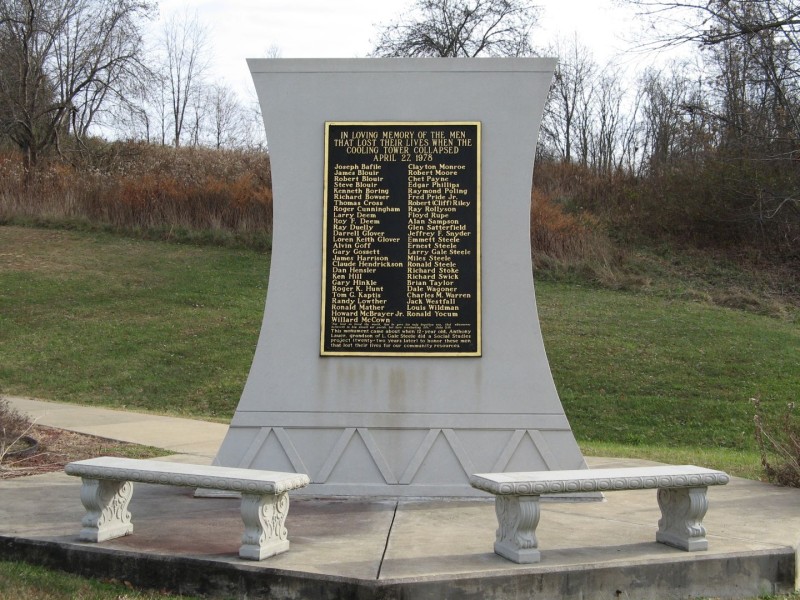
This Week in American History: 1978 – 51 Workers Die in Nuclear Construction Accident
• Apr. 27. In 1978, construction is underway on a second cooling tower at the Pleasants Power Station in Willow Island, West Virginia. The tower had reached a height of 166 feet when about 10 am, concrete poured the previous day began to collapse. Concrete, wooden forms, and metal scaffolding began collapsing to the ground inside the tower. Falling to their deaths were 51 construction workers. An investigation resulted in the company being cited for 20 safety violations. It remains the deadliest construction accident in US history.

DID YOU KNOW …? Did the set of a 1982 horror movie feature a poster for something that would not happen for another six years?
Trying to come up with an introduction to the column this week is akin to trying to pan for gold in that lake in Yellowstone Park that dissolves you … I’m having no success at all.
So, for the rare moment, I’ll just say the heck with it, wish you a wonderful week, and send you on to the trivia. Enjoy!

* This Do In Remembrance Of Me *
Greetings and blessings! “Then He (Jesus) took the bread, spoke a blessing and broke it, and gave to them (Apostles), saying, ‘This My body, given for you; do this in remembrance of Me.’’’ (Luke 22:19). And in (1 Corinthian 11:25), it refers to the cup or wine where Jesus says, “This cup/wine is a new covenant in my blood. Do this, as often as you drink it, you do in remembrance of me.” It was Jesus’ blood that was shed for the forgiveness of our sin. (Read Matthew 26:28).
So, today I come with the finality of a series of deep enlightenment on the biblical and spiritual significant of Jesus’s death, burial, resurrection and ascension into Heaven. I certainly pray that you’ll gain perhaps some or more knowledge of the amazing, more so, the divine crucifixion of our Lord, and Saviour, Jesus Christ.