
Identifying the Real Issue
In just the last few weeks an increasing number of proposed data center locations have been reported throughout an expanding area relatively close to the coverage area of this newspaper.
It might well be that companies desiring to construct data centers could be leaking potential location rumors just to identify those areas less antagonistic to the idea. Opposition to data centers spreads rapidly – most often on social media – which is quite humorous as the increasing use of social media is one of the issues driving the need for more data centers.
Just recently a social media post highlighting the potential negative impacts of data centers made the rounds on social media – yet again. Included among those negative impacts were increased electrical use and infrastructure, increased water use and infrastructure, increased property values and taxation, noise and traffic, environmental concerns, and negative impact on wildlife. Those issues, and more, are legitimate concerns and have repeatedly been raised concerning development of … subdivisions.
By Andy Kober
In just the last few weeks an increasing number of proposed data center locations have been reported throughout an expanding area relatively close to the coverage area of this newspaper.
It might well be that companies desiring to construct data centers could be leaking potential location rumors just to identify those areas less antagonistic to the idea. Opposition to data centers spreads rapidly – most often on social media – which is quite humorous as the increasing use of social media is one of the issues driving the need for more data centers.
Just recently a social media post highlighting the potential negative impacts of data centers made the rounds on social media – yet again. Included among those negative impacts were increased electrical use and infrastructure, increased water use and infrastructure, increased property values and taxation, noise and traffic, environmental concerns, and negative impact on wildlife. Those issues, and more, are legitimate concerns and have repeatedly been raised concerning development of … subdivisions.
NOT far from where I live, attempts are being made to rezone land that has been zoned agricultural, to residential for development of yet another subdivision – another subdivision that will bring some of the same issues as data centers.
Information on the proposed development indicates less than 200 homes will be built and whatever the final number, these homes will result in increased electrical usage, and increased water usage.
Over the last year, improvements were made to electrical service infrastructure in that area, and over the last two weeks new utility poles were being installed along the property’s road frontage. Coincidence?
The property is located along a narrow, curvy, county road with a 45 miles per hour speed limit. Assuming 160 houses, which is likely low, will result in at least an additional 320 cars. That’s just for two adults; add a teenager or two per household and the number of vehicles could easily surpass 500 on an almost daily basis – using a county road that has very limited sight distances. Anyone who believes that teenagers will obey that 45 mph speed limit will likely believe that most of the adults will as well. With some of those drivers will come abrasively loud exhaust and sound systems in their cars. Sadly, law enforcement patrols along that road will be minimal because of the limited number of deputies available.
Subdivisions also cause environmental concerns from stormwater runoff into creeks and streams, widespread cutting of trees and clearing of flora and fauna, along with causing widespread negative impacts to wildlife.
And, of course, subdivisions drive up property values not only inside the development, but neighboring properties as well, and increased value results in increased taxation.
The very complaints about the potential negative impacts of data centers, can and do apply to subdivisions as well.
Data centers or subdivisions; as a smart person once said, “Pick your poison.”
IN the final analysis, the issue is about land and money.
With some exceptions, previous generations farmed the land or raised livestock on it. Nearly every day from dawn to dusk, they worked the land. It was hard, brutal, and sometimes unrewarding work as multiple generations of families were raised on the land. It was a life that required tremendous courage and significant sacrifice.
Those generations are gone now as are their stories. Over the ensuing generations, the land that was once so important to their lives, was left to their heirs and then possibly sold outside the family. Life has changed and the land that once meant so much is no longer important. In fact, it has become a financial liability at tax time.
Then along comes developers, like a plague of locusts, offering fast cash for that land that is now overgrown with trees and undergrowth.
The rest of that story we are seeing much too often.
That’s my opinion.
Andy Kober can be reached by email at andykober@hotmail.com
Before you go...
Thanks for reading The Talbotton New Era. We hope this article added to your day.
We are a nonprofit, local newsroom that connects you to the whole story of Talbot county. We live, work and play here. Our reporting illuminates and celebrates the people and events that make Middle Georgia unique.
If you appreciate what we do, please join the readers like you who help make our solution-focused journalism possible. Thank you
Author

Related Articles

Andy’s Astronomy: Back to the Moon
Last week I sat in front of the television watching the countdown and final liftoff as Artemis II not only returned humans to space, but back to the Moon as well.
I did the same over 50 years ago, watching Gemini and Apollo missions until in 1969, humans landed on the Moon. I can still hear the narration by CBS News anchor Walter Cronkite.
As this is being written, the Orion capsule is less than 60,000 miles from the Moon, already having flown a distance exceeding 219,000 miles with a speed of over 1,500 miles per hour. To track the Orion capsule, go to https://www.nasa.gov/missions/artemis-ii/arow/
Godspeed to the astronauts on board. Fly safe as you lead us back into space.

This Week in American History: 2014 – Student Stabs 20 Others at Penn. High School
• Apr. 9. On this day in 2014, 16-year old Alexander Hribal enters Franklin Regional High School in Murrysville, Pennsylvania, carrying two eight-inch kitchen knives. At about 7:15 am, Hribal stabs and slashes several students, then activates a fire alarm, bringing more students into the hallways and attacks more. Quick reaction by the school’s assistant principal and another student results in Hribal being subdued. Twenty students are injured, with some of the injuries severe, but there are no fatalities. Hribal will be charged on multiple counts, convicted, and sentenced to 23-1/2 years to 60 years. He is currently incarcerated at the State Correctional Institution in Albion, PA. Evil does not need a firearm.
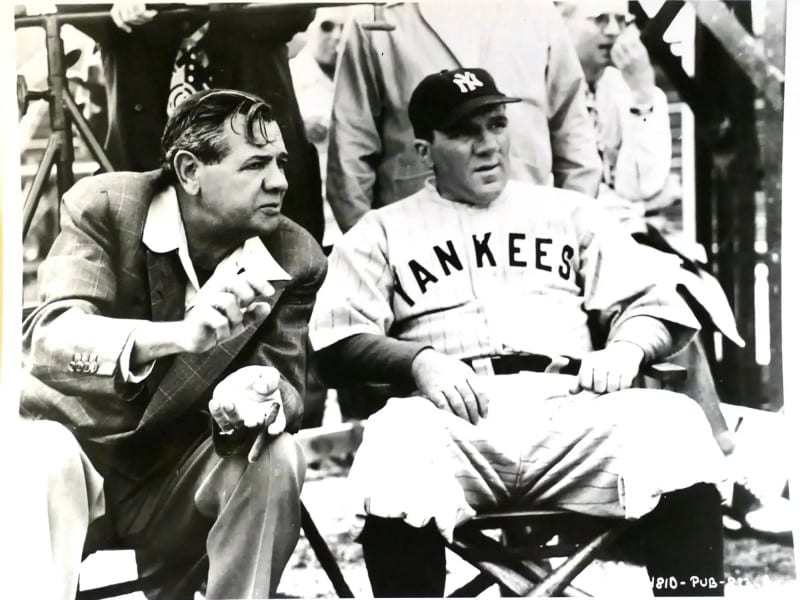
DID YOU KNOW …? Did a baseball star and the actor who played him in a movie have a previous connection in their lives?
So, how did you do?
Last week was the annual April Fool edition of this silly column, wherein I set three items that were totally false, and you had to figure out which ones they were. You probably said, “He’ll just tell me next week,” and went on with your day.
You were right; I will tell you. The incorrect ones were:
1. The liter was not named after a person. The story about Claude Èmile Jean-Baptist Litre was created in 1978 by a student at the University of Waterloo to justify using a capital “L” to denote the unit of measurement.
2. Bagpipes are not a Scottish invention. Instruments similar to the pipes have been recorded in Middle Eastern nations during the earliest part of the modern era, long before they arrived in Scotland.
3. The Morse code for “SOS” does not mean anything specific. It’s simply three dots, three dashes, and three dots, and very quick and easy to send repeatedly.
And yes, as silly as it sounds, the one about Pistols ‘n Petticoats is a real item, not a gag.
I hope you got them all! Now get this …